Article

Portugal Homes
Get the best property advice.
The Schengen Area is a shared zone in the European continent where participating countries have abolished the need for visas, passports, and other types of border control measures.
Third-country nationals, meaning citizens from any country not within the EU or who do not enjoy the right to free movement, such as the United States, India, or China, can still access the countries within the Schengen Area, albeit under normal border control policies.
One of the most important rules to keep in mind is the 90-180 Schengen rule.

Why Does This Affect Portugal?
In 1995, Portugal signed the Schengen Convention.
Ever since, it's been part of the shared Schengen Zone, a common area where the borders have been abolished.
Founded by the idea of freedom of movement, nationals from Schengen states can move freely, work, and live in each other’s territories without special formalities.
As a Schengen state, the 90-day rule applies to Portugal.
What is the Difference Between the European Union and the Schengen Zone?
It is important to note that the EU and the Schengen Zone are not mutually exclusive.
A country can be in the EU and not in the Schengen Zone. Likewise, a country can be in the Schengen Zone, and not in the EU.
While the EU is a political and economic union, the Schengen Zone is a common area ruled by freedom of movement.
As of February 2026, the EU has 27 Member States:
Austria | Italy |
Belgium | Latvia |
Bulgaria | Lithuania |
Croatia | Luxembourg |
Cyprus | Malta |
Czechia | The Netherlands |
Denmark | Poland |
Estonia | Portugal |
Finland | Romania |
France | Slovakia |
Germany | Slovenia |
Greece | Spain |
Hungary | Sweden |
Ireland |
The only EU countries that are not part of the Schengen Zone are Cyprus and Ireland.
Traveling to these countries will require understanding each country’s visa policies. Ireland, due to its Common Travel Area shared with the United Kingdom, operates its own visa policy. Cyprus is currently under evaluation to join the Schengen Zone.
Furthermore, 4 other non-EU member states are part of the Schengen Zone: Iceland, Lichtenstein, Norway, and Switzerland, which together form the European Free Trade Association (EFTA).
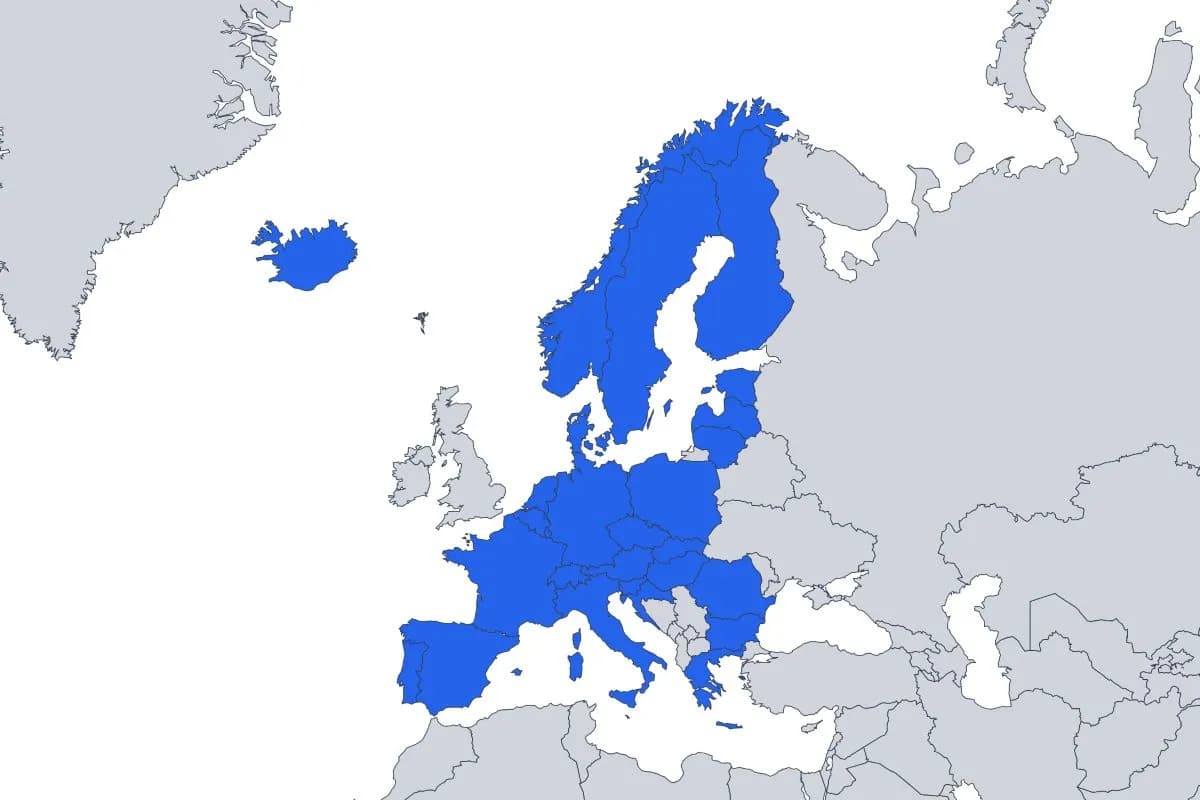
The Schengen Zone 90/180-Day Rule Explained
To control its external borders and verify the legal status of those who enter the Schengen Zone, the signatory states consider short stays if they do not surpass the threshold of 90 days.
If a traveller seeks to stay in any of the Schengen states for longer than 90 days, they must either acquire a long stay visa or a residency permit.
When a third-country travels to a Schengen state, and if they do not have any intention of surpassing the threshold, they can only stay for a maximum of 90 days within a period of 180 days.
The 180-day period starts ticking on the day the traveller first steps into any of the 27 countries in the Schengen Zone.
.jpg&w=3840&q=75)
Here’s an example to help explain the Schengen Area 90-day rule:
Landing in Lisbon on January 1st and staying in Portugal for 90 days in a row means having to leave the Schengen Area by March 31st.
You can come and go as you wish as long as your time inside Schengen never exceeds 90 days within the last 180 days.
You can stay in Schengen up to June 29th, if you don't use your 90 days in a row.
You may re-enter as soon as enough earlier days drop out of the last-180-day window.
This means that, even if you did use your 90 days in a row and left by March 31st, you can still make a trip from September 1st to September 10th.
In this situation, you still have 64 days available. Why? Because the previous 180 days run from March 6th to September 1st, which only contains 26 of your Jan–Mar days.
If you want to arrive with a fresh 90-day allowance at entry, wait until the last 180-day window contains no past stays, which would only be possible from September 28th onward (March 31 + 180 days).
The EU is also expected to tighten entry and exit requirements with its new “Smart Borders” policies.
Obtain Unlimited Schengen Entry with Portuguese Residency
If you wish to stay in Portugal for more than 90 days without the need to leave the country or the Schengen Zone, obtaining Citizenship is a must, and getting a Residency Permit is the first step toward it.
Portugal is one of the safest countries to live in the world, with an affordable quality of life, and excellent healthcare.
Both the Portugal Golden Visa and the D2 Visa enables benefits such as family reunification, visa-free travel to the Schengen Zone, and opportunities to expand into the EU and the rest of the world.




Talk to one of our Real Estate Experts
Frequently Asked Questions
Talk to one of our Real Estate Experts
Portugal Homes
Get the best property advice.